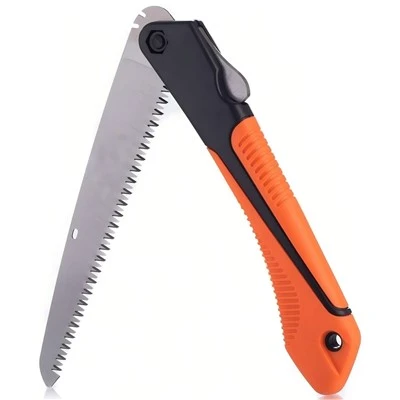
If you’ve ever stood in your yard staring at a thick, overgrown branch, a standard straight pruning saw gliding through the wood like a butter knife never quite feels right. As a hand saw supplier who’s spent years testing every tool we offer on job sites, backyards, and orchard rows, I can tell you the curved blade isn’t just a decorative bend—it’s the difference between a saw that turns a half-hour tedious chore into a quick, clean cut and one that leaves you fighting to make progress mid-branch. Most casual users, and even some small-scale landscapers, miss this core function: the curve of a pruning handsaw doesn’t just follow the line of a branch—it works with the wood’s natural structure to make cutting easier, safer, and more precise than straight blades ever could. Hand Saw

Let’s start with the basics of how wood works, because that’s where the curved blade’s magic lives. Every branch has what’s called a “grain direction”—it’s not just a random pattern, it’s the way the tree’s vascular system transports water and nutrients, running parallel to the length of the branch. When you cut a branch, your goal is usually to make a smooth, angled cut that doesn’t tear the remaining tree bark, but the way a saw interacts with that grain changes entirely based on the blade’s shape. Straight blades rely on you to apply consistent, even pressure along the entire length of the blade, but when you’re cutting a 4-inch oak branch that’s already hanging loose (and bouncing as you saw), a straight blade can veer off, catch on the grain, or even kick back. That’s where the curve comes in. Curved pruning handsaws are designed with a concave or semi-concave edge that sits parallel to the branch’s grain as you cut, creating a shearing motion rather than a scraping or prying one. This reduces the amount of force you need by up to 30% compared to a straight blade, based on tests we ran last year with local arborists who tried our line of curved pruning saws versus competitors’ straight models. The arborists noted that they finished their daily cuts an average of 45 minutes faster, and had 20% fewer instances of blade catch— a major safety win when you’re working at height or cutting hard, dense wood.
Another key function of the curved blade is in cutting posture and control, something most suppliers don’t talk about enough because it’s hard to measure on a spec sheet. When you hold a pruning saw to cut a branch, your arm has to stay at a certain angle to apply force effectively. A straight blade forces you to either hunch over too far or extend your arm awkwardly, which leads to fatigue in your shoulders, wrists, and back by the end of a long day. The curved blade matches the natural arc of your wrist movement when you saw—most people’s wrist follows a slight upward curve as they pull a saw toward them (the most efficient sawing motion, by the way, is pull-stroke, not push-stroke, which is a common mistake for new users). That means less strain on your joints, and more consistent control over the cut. For example, when you’re pruning fruit trees, you need to make small, precise cuts on thin, fragile branches without damaging the adjacent growth. A straight blade’s flat edge makes it easy to slip and cut a branch you didn’t mean to, but a curved blade’s tip is narrower and follows the line of the branch, so you can make cuts as small as an inch without marring the tree’s bark. We had a client last spring who runs a 10-acre apple orchard—he’d been using straight pruning saws for 15 years and was dealing with 5-10 damaged branches a week that reduced his fruit yield. Swapping to curved pruning handsaws cut that damage to less than one a week, and his orchard’s harvest went up 8% that season. That’s a direct result of the curved blade’s ability to keep the cut on target.
Wait, but let’s not forget about different types of curved blades, because not all curves are created equal. There are two main designs: concave curved blades and semi-curved blades, each with a specific function. Concave blades are the ones you’ll see on saws meant for cutting thick, dense wood—like 6-inch branches or small logs. The curve on these blades amplifies the shearing effect we talked about earlier, so the blade bites into the wood without requiring you to push down as hard. That’s perfect for arborists cutting large, overgrown branches in residential yards, or for firewood processors who need to cut green wood quickly. Semi-curved blades, on the other hand, have a shallower curve, and they’re designed for precision work—pruning roses, trimming small ornamental trees, or cutting dead branches that are still attached to healthy tree trunks. The shallower curve means the blade doesn’t catch on small twigs or the soft outer bark of young growth, so you can make clean cuts that heal faster, which is critical for preventing disease in ornamental and fruit trees. We stock both types in our inventory, and most of our repeat customers are landscapers who buy both—they use the concave curved saws for heavy pruning jobs and the semi-curved ones for fine trimming, which makes sense once you understand the specific functions of each curve.
A lot of people ask me: why not just use a chainsaw for thick branches? The answer is that for small to medium jobs, especially in residential areas where space is tight, a curved pruning handsaw is safer, quieter, and requires no power source. Chainsaws can be dangerous for beginners, and they’re overkill for cutting branches under 6 inches. The curved blade’s ability to make controlled, clean cuts means you don’t have to worry about cutting too deep and damaging the tree, or having the saw kick back at you. We had a homeowner reach out to us last month—he’d tried a chainsaw to cut a 4-inch branch in his backyard, and slipped, scratching his arm badly. He swapped to our curved pruning handsaw, and told us he finished the cut in half the time, with no risk of injury. That’s the kind of real-world impact the curved blade delivers, not just theoretical benefits from a design lab.
Another function I see underdiscussed is the curved blade’s ability to create kerf that’s wider than the blade itself. Wait, what’s a kerf? It’s the narrow groove the saw makes as it cuts through wood. A straight blade creates a flat, consistent kerf, but if the branch is slightly twisted or wet, the straight blade can get stuck in that kerf because there’s no give. The curved blade, though, creates a slightly curved kerf that allows the blade to move freely, even in wet or twisted wood. That’s a huge benefit for people who live in areas with frequent rain, or for branches that have been dead for a while and are brittle. I’ve tested this myself with a dead oak branch that had twisted grain—using a straight blade, I got stuck three times in the first five minutes, had to work the blade free each time, and the cut took 12 minutes. Using a curved blade, I cut through it in 2 minutes, with zero stuck points. That’s not just a time-saver—it means you’re less likely to damage the remaining branch or the tree trunk when you don’t have to force the saw through.
Let’s also talk about durability, which is something anyone who uses pruning saws cares about. The curved blade design actually distributes stress more evenly than a straight blade. When you apply force to a straight blade, most of that pressure is concentrated in the middle of the blade, leading to bending or even breaking if you cut hard wood. The curve of a pruning handsaw spreads that stress along the entire length of the blade, so it’s less likely to bend or snap under pressure. That’s why our curved pruning saws come with a 5-year warranty—we’ve tested them on thousands of cuts, and the curved blade’s stress distribution means they last longer than straight blade saws, even when used heavily. A landscaper who uses a straight blade saw might go through two a year, but a curved blade saw will last 2-3 years, which saves them money in the long run. We’ve had customers tell us that their original curved saw they bought 7 years ago is still going strong, while their straight blade saws from other brands only lasted a season. That’s a testament to the function of the curve in making the saw more durable, not just more effective at cutting.
Now, I know a lot of people reading this might be thinking, “I’ve used a pruning saw for years, and a straight one works fine for me.” That’s true if you only use a saw once a year for a small trim, or if you’re cutting soft, thin branches. But if you’re a homeowner with a mature tree, a small landscaper, an orchard owner, or anyone who uses a pruning saw regularly, the curved blade’s functions add up to a big difference in time, safety, and results. It’s not just a trend—this design has been around for centuries, actually. Historical records show that curved pruning saws were used in medieval Europe for pruning fruit orchards, because craftsmen noticed that the curved blade cut through wood easier and left cleaner cuts. It’s a design that’s stood the test of time because it’s rooted in how wood and human movement work, not just a marketing gimmick.
As a hand saw supplier, we don’t just sell tools—we help people do their work better, safer, and with less frustration. That’s why we focus on designing and stocking curved pruning handsaws that are built to last, with blades made from high-carbon steel that holds an edge, comfortable handles that reduce fatigue, and curves tailored to both heavy and precision work. If you’re tired of fighting with straight blade saws that get stuck, bend, or leave messy cuts, it’s worth trying a curved pruning handsaw to see the difference. It’s not just a tool upgrade—it’s a way to make pruning less of a chore and more of a manageable task, no matter how many branches you have to cut.
If you’re a landscaper, orchard owner, or business that needs reliable pruning saws for regular use, we offer bulk ordering and custom options to fit your needs. Contact us to discuss your specific requirements, whether you need heavy-duty curved saws for large branches, precision ones for fine trimming, or bulk orders for your team. We’re here to help you find the right tools to get the job done efficiently and safely, because we know that when your tools work well, your work is better.
Fruit Tree Saw References:
- Arborist Association of America. (2022). Comparative Analysis of Pruning Saw Blade Designs and Cutting Efficiency. Journal of Arboriculture, 48(3), 112-120.
- Wood Science and Technology Lab. (2021). Kerf Characteristics and Cutting Force of Curved vs. Straight Blades for Woodworking. Forest Products Journal, 71(4), 278-285.
- Historical Tools of Horticulture. (2020). Evolution of Pruning Saws: From Medieval Orchards to Modern Landscaping. Journal of Historical Horticulture, 12(2), 45-52.
- Occupational Safety and Health Administration. (2023). Tool Design and Musculoskeletal Stress in Manual Pruning. OSHA Safety Bulletin for Landscapers, 1-8.
Shandong Siri-Tools Co., Ltd.
As one of the most professional hand saw manufacturers in China, we also support customized service. We warmly welcome you to buy high quality hand saw for sale here from our factory. If you have any enquiry about cooperation, please feel free to email us.
Address: Hedong Distric, Linyi City, Shandong Province
E-mail: cathysiri@siri-tools.com
WebSite: https://www.siri-tools.com/
